
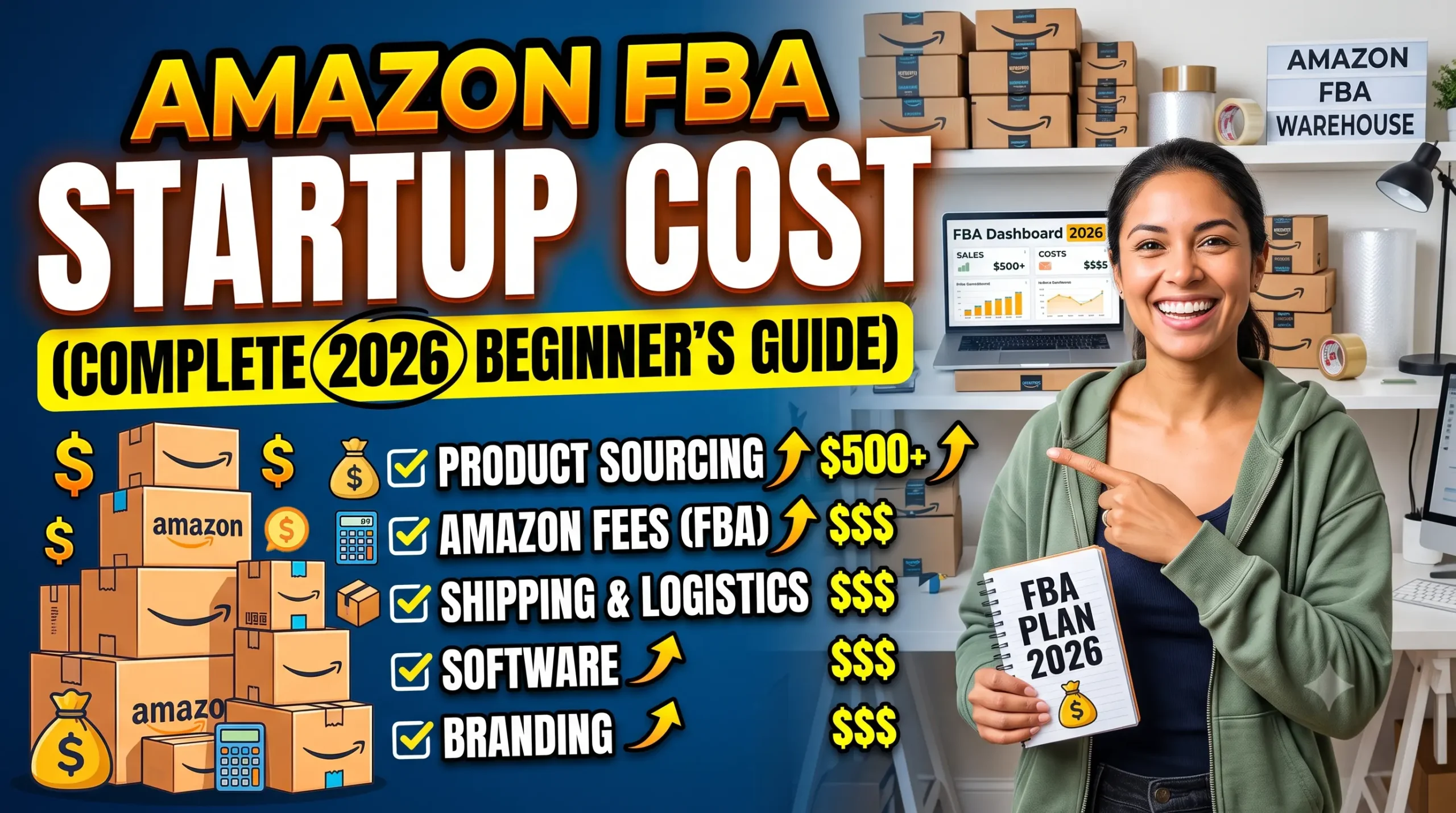
Wondering about the Amazon FBA startup cost in 2026? Many beginners are surprised to learn that you can launch a profitable Amazon FBA business with as little as $2,000–$5,000, though realistic budgets often range from $3,000–$10,000+ depending on your model (retail arbitrage, wholesale, or private label). This comprehensive guide breaks down every expense, provides real-life examples, and includes a data table to help you plan effectively.
Starting an Amazon FBA (Fulfillment by Amazon) business is a realistic and affordable way to enter the e-commerce world. While it’s a common misconception that launching this kind of business requires a large upfront investment, the truth is you can begin with a relatively modest budget, and scale up gradually as your business grows.
Whether you have $500 or $55,000, the key is knowing how to allocate your funds effectively and understanding the essential costs involved.
Initial Budget Considerations
Amazon FBA does not require tens of thousands of dollars to get started. Many beginners have successfully launched their businesses with as little as $400 to $500. This budget is practical for sourcing inventory, especially if you use methods like Retail Arbitrage or Online Arbitrage, which involve buying discounted products and reselling them on Amazon.
For those with more capital, such as $10,000 or $20,000, investing in wholesale inventory is a viable way to scale faster. Wholesale involves purchasing products directly from established brands like Sony, Logitech, or Fiji, often requiring minimum order quantities that can range from $5,000 to $10,000.
This approach allows for ordering larger quantities at wholesale prices, which increases your potential profit margins and sales volume.
Methods To Start With Different Budgets
Here’s how you can start based on the amount you have available :
- Under $500 : Utilize Retail Arbitrage or Online Arbitrage. These methods require no special paperwork or legal documents and allow you to buy smaller quantities of products from stores or online retailers to resell on Amazon.
- $500 to $1,000 : Continue with arbitrage but increase your inventory size to boost potential earnings. This amount is sufficient to buy 10 units of a product, which you can flip on Amazon and reinvest your earnings to grow.
- $5,000 to $10,000 : Consider starting with wholesale. This requires legal documents such as an LLC and a reseller’s permit but gives access to higher-quality brands and bulk purchasing options.
- $10,000 and up : Wholesale is the best option for scaling quickly. You can order hundreds of units at a time and significantly increase your monthly revenue.
Scaling Your Business Over Time
The natural progression for most Amazon sellers is to start small and scale as profits allow. Beginning with a $500 inventory budget enables you to learn the ropes without risking too much money. As you reinvest your earnings, you can increase inventory size, expand product lines, and eventually transition into wholesale purchasing for even greater growth potential.
Many successful sellers have built six-figure or even seven-figure businesses from modest beginnings by consistently reinvesting profits and utilizing smart sourcing strategies.
Cost Breakdown Example
| Expense | Estimated Cost | Notes |
|---|---|---|
| Amazon Seller Account | $40/month | Essential for selling on Amazon |
| Product Research Software (e.g., Scam Profit) | $40/month | Optional but highly recommended for profitable product research |
| Inventory | $500 (minimum recommended for beginners) | For sourcing initial products via arbitrage or wholesale |
| Legal Documents (LLC & Reseller’s Permit) | $100 – varies by state | Required only if you plan to do wholesale |
Summary
In total, starting an Amazon FBA business can cost as little as around $600 a month, including inventory, software, and the seller account. This is considerably lower than traditional brick-and-mortar businesses or franchises, which often require tens of thousands of dollars upfront.
The affordability, combined with Amazon’s massive customer base, makes FBA an attractive option for entrepreneurs looking to start a business with limited capital.
Cost Of An Amazon Seller Account
The Amazon Seller Account is the cornerstone of your FBA business. Without it, you cannot sell on Amazon’s platform. Understanding the costs and benefits of this account is crucial for anyone considering starting an Amazon FBA business.
Types Of Amazon Seller Accounts
Amazon offers two main types of seller accounts :
- Individual Seller Account : This account has no monthly fee but charges $0.99 per item sold. It is ideal for those just starting or selling fewer than 40 items a month.
- Professional Seller Account : This account costs $40 per month (plus other selling fees) and is best suited for sellers planning to sell over 40 items monthly or who want access to advanced selling tools and reports.
In the video and most professional FBA businesses, the $40/month Professional Seller Account is highly recommended. It provides full access to the platform and tools necessary for scaling your business effectively.
Benefits Of The Professional Seller Account
For $40 a month, the Professional Seller Account offers significant advantages :
- Access to over 150 million customers in the U.S. alone : Amazon’s marketplace hosts more than 50% of U.S. online shoppers.
- No per-item selling fees : Unlike the Individual Seller Account, you won’t pay $0.99 per sale, which saves money if you sell in volume.
- Advanced selling tools : Access inventory management, advertising options, bulk listing tools, and detailed sales reports.
- Eligibility for Buy Box : Only Professional Sellers can compete for the Buy Box, which is crucial for driving sales.
Why The $40 Monthly Fee Is Worth It
Although $40 per month may seem like an upfront cost, when compared to the exposure and tools it unlocks, it’s a very affordable investment. The platform brings millions of buyers to your doorstep, meaning you don’t need to spend additional money on marketing to drive traffic to your listings.
This built-in customer base is one of Amazon FBA’s biggest advantages.
Additional Selling Fees
Besides the $40 monthly subscription, sellers should be aware of other fees that Amazon charges :
- Referral Fees : Amazon charges a percentage of each sale, typically ranging from 6% to 15%, depending on the product category.
- Fulfillment Fees : If you use Amazon FBA, there are fees for picking, packing, and shipping your products, which vary based on size and weight.
- Storage Fees : Monthly storage fees apply for products held in Amazon’s warehouses.
These fees are variable and depend on your product type and sales volume but should be factored into your pricing and budgeting.
Summary
In conclusion, the cost of an Amazon Seller Account is primarily the $40 monthly fee for the Professional Seller Account, which is essential for anyone serious about building a scalable Amazon FBA business. This fee grants access to a massive market and tools that make managing your business easier and more efficient.
When combined with other costs like inventory and software, the seller account fee is a foundational expense that enables your e-commerce venture to thrive.
Essential Software For Amazon Fba : Scan Profit Overview
When starting an Amazon FBA business, having the right software tools is crucial for success. Among the numerous software options available, Scan Profit stands out as a comprehensive all-in-one solution that combines multiple functionalities in one platform, streamlining your product research and profitability analysis.
What Is Scan Profit?
Scan Profit is an advanced Amazon seller software that helps you find profitable products to sell on Amazon. It leverages AI technology to provide deep insights into product profitability, sales velocity, competition, and market demand, enabling you to make informed decisions and minimize risks.
Key Features Of Scan Profit
- Product Research : Scan Profit helps you identify products with high demand and profitability. It scans through millions of listings and highlights items that are worth investing in.
- Profit Calculation : It accurately calculates the profit per unit by factoring in Amazon fees, shipping costs, and other expenses, giving you a clear picture of your potential earnings.
- Sales Data Tracking : The software shows how many units of a product are sold each month, helping you understand market trends and sales velocity.
- Competition Analysis : It reveals how many sellers are competing on a specific listing, allowing you to gauge the level of competition.
- AI-Powered Insights : By using artificial intelligence, Scan Profit automates much of the research process, doing up to 90% of the work for you, which saves time and reduces guesswork.
Benefits Of Using Scan Profit
Before tools like Scan Profit existed, Amazon sellers had to manually analyze listings, sales numbers, and fees, which was time-consuming and risky. Many sellers took chances without solid data, often losing money on products that didn’t sell well. Scan Profit changes the game by providing accurate, real-time data and AI-driven insights, allowing sellers to :
- Make safe investments by only purchasing products with verified demand and profitability.
- Reduce risks associated with product sourcing by having a clearer understanding of market dynamics.
- Save time on manual calculations and market research.
- Increase chances of building a profitable Amazon business from the start.
Cost And Trial
Scan Profit costs approximately $40 per month, which is a reasonable investment considering the value and time saved. Additionally, it offers a 7-day free trial that allows new users to explore its features and determine if it fits their business needs before committing financially.
Summary
In summary, Scan Profit is an essential software tool for anyone serious about starting or scaling an Amazon FBA business. By combining product research, profit calculation, and sales tracking into one platform, it empowers sellers to make data-driven decisions, minimize risk, and maximize profits efficiently.
Legal Requirements For Wholesale : Llc And Reseller’s Permit
If you are planning to dive into wholesale selling on Amazon, understanding and fulfilling the legal requirements is essential. Selling wholesale often involves setting up accounts with large brands and suppliers, which typically require specific legal documentation to verify your business status.
Why Legal Documents Matter For Wholesale
Wholesale suppliers and brands such as Sony, Logitech, and Fiji expect sellers to be legitimate businesses before granting access to their wholesale accounts. This is to ensure compliance with tax laws, protect brand integrity, and verify the reseller’s legitimacy. Two key legal documents are typically required :
- Limited Liability Company (LLC)
- Reseller’s Permit
Limited Liability Company (llc)
An LLC is a business structure that legally separates your personal assets from your business liabilities. Forming an LLC provides personal liability protection and can offer tax benefits, making it a popular choice for Amazon sellers.
The cost to establish an LLC varies by state. For example, in Georgia, the cost is approximately $100. To form an LLC, you generally need to visit your state’s Secretary of State website and file the necessary paperwork online. The process is straightforward and can often be completed without legal assistance.
Reseller’s Permit
A reseller’s permit (sometimes called a sales tax exemption certificate) allows you to purchase products from wholesalers without paying sales tax, provided you intend to resell those products. This permit is essential for wholesale operations to avoid double taxation.
Obtaining a reseller’s permit is usually free or low-cost, depending on your state. You can apply for it by visiting your state’s Department of Revenue website. For instance, in Georgia, you would search for “Department of Revenue Georgia reseller’s permit” to find the application process.
How These Documents Enable Wholesale Selling
Having an LLC and reseller’s permit enables you to :
- Open wholesale accounts with big brands directly.
- Order inventory in bulk, often at discounted prices.
- Build relationships with suppliers and negotiate better terms.
- Comply with tax regulations and avoid legal issues.
Optional Nature Of Legal Documents For Amazon Sellers
It’s important to note that while an LLC and reseller’s permit are necessary for wholesale, they are optional if you plan to pursue other Amazon selling methods such as Retail Arbitrage or Online Arbitrage. These methods allow you to source products from retail stores or online marketplaces without the need for formal business paperwork.
Summary
In conclusion, if wholesale is your chosen path on Amazon, securing an LLC and reseller’s permit are fundamental steps to legally and effectively operate your business. They help establish your credibility with suppliers and ensure compliance with tax laws, enabling you to scale your wholesale business confidently.
Different Amazon Selling Methods : Wholesale Vs. Retail And Online Arbitrage
When starting an Amazon FBA business, it’s essential to understand the different selling methods available. The main approaches include wholesale, retail arbitrage, and online arbitrage. Each method has distinct characteristics, costs, and legal implications, which affect how you start and scale your business.
Wholesale Selling
Wholesale involves purchasing products directly from manufacturers or authorized distributors in bulk at discounted prices and then reselling them on Amazon. This method is often favored by sellers with a larger budget who want to scale quickly.
Key Characteristics Of Wholesale :
- Bulk Purchasing : Typically involves ordering hundreds of units at minimum order quantities (MOQs).
- Legal Requirements : Requires an LLC and reseller’s permit to open wholesale accounts with brands.
- Higher Initial Investment : Minimum order quantities and bulk purchases often require $5,000 to $10,000 or more upfront.
- Brand Relationships : Enables direct partnerships with major brands like Sony and Logitech.
- Scalability : Allows faster growth due to larger inventory and better pricing.
Retail Arbitrage
Retail arbitrage is the practice of buying discounted products from retail stores such as Costco, Sam’s Club, or Walmart and reselling them on Amazon for a profit.
Key Characteristics Of Retail Arbitrage :
- Low Startup Cost : You can start with as little as $500 for inventory.
- No Legal Paperwork Required : You do not need an LLC or reseller’s permit.
- Smaller Inventory Sizes : Purchases tend to be in smaller quantities compared to wholesale.
- Requires Time for Sourcing : You must physically visit stores to find deals.
- Good for Beginners : Ideal for sellers who want to test the waters and scale gradually.
Online Arbitrage
Online arbitrage is similar to retail arbitrage but involves purchasing discounted products from online stores and reselling them on Amazon.
Key Characteristics Of Online Arbitrage :
- Convenient Sourcing : No need to visit physical stores; product sourcing happens online.
- Low Startup Cost : Like retail arbitrage, you can start with a modest inventory budget.
- No Legal Paperwork Required : LLC and reseller’s permit are not necessary.
- Requires Research Skills : You need to identify discounted products and ensure they sell well on Amazon.
Cost Comparison
| Method | Legal Requirements | Starting Inventory Cost | Monthly Software Costs | Scalability |
|---|---|---|---|---|
| Wholesale | LLC + Reseller’s Permit | $5,000 to $10,000 or more | Approx. $80 (Amazon Seller Account + Scan Profit) | High |
| Retail Arbitrage | None | Approx. $500 | Approx. $80 (Amazon Seller Account + Scan Profit) | Moderate |
| Online Arbitrage | None | Approx. $500 | Approx. $80 (Amazon Seller Account + Scan Profit) | Moderate |
Which Method Is Right For You?
Your choice depends largely on your budget, risk tolerance, and long-term business goals :
- If you have a larger budget ($5,000+), want to scale quickly, and are willing to handle legal paperwork, wholesale is the ideal method.
- If you’re starting with a smaller budget (under $1,000), retail or online arbitrage offers a lower barrier to entry without the need for legal formalities.
- Retail and online arbitrage also provide a way to gradually build capital that can later be reinvested into wholesale purchasing.
Summary
Understanding the differences between wholesale, retail arbitrage, and online arbitrage is critical for starting your Amazon FBA business on the right foot. Wholesale requires more initial investment and legal setup but offers faster scalability, while retail and online arbitrage provide accessible entry points with lower upfront costs and fewer legal obligations.
Choosing the right selling method depends on your individual circumstances, resources, and business objectives.
Inventory Costs And Budgeting For Amazon Fba
Inventory is the cornerstone of any Amazon FBA business. Without products to sell, there is no business. One of the biggest misconceptions among new sellers is that you need to invest tens of thousands of dollars to get started. However, this is simply not true.
In fact, it’s possible to start your Amazon business with as little as $500 allocated for inventory.
Starting Inventory Budget
For beginners with limited capital, Retail Arbitrage or Online Arbitrage can be an excellent entry point. This method involves purchasing products from physical stores like Costco, Sam’s Club, or Walmart, or from websites offering discounted products, and reselling them on Amazon.
You can start small by buying around 10 units of a product and then listing them on Amazon. When you receive your Amazon payout, you reinvest the profits into purchasing more inventory. This gradual scaling approach is both practical and effective.
Setting aside about $500 for your initial inventory is a reasonable and manageable amount. It allows you to test the waters without risking a large sum of money upfront. Many successful Amazon sellers began with similar or even smaller amounts and built their businesses to six and seven-figure revenues over time.
Inventory Budget For More Experienced Sellers
If you have a larger budget, say $10,000 or more, you might consider wholesale sourcing. This method involves opening wholesale accounts with big brands like Sony or Fiji and ordering products directly from them. Wholesale orders typically come with minimum order quantities (MOQs), which may require an initial investment ranging from $5,000 to $10,000 or less depending on the supplier and product line.
With wholesale, you can order hundreds of units at a time, which means more products to sell and potentially higher profits. However, this approach requires legal documents such as an LLC and a reseller’s permit, which add to your startup costs but open doors to larger-scale purchasing and brand partnerships.
Monthly Inventory Spending
Inventory costs should be viewed as an investment rather than just an expense. The initial $500 you spend on inventory is expected to generate returns every month as you sell your products. For sellers operating on a wholesale model, monthly inventory spending can be around $2,000 or more, depending on your growth goals and sales volume.
For Retail or Online Arbitrage sellers, monthly inventory costs typically hover around $500. This lower amount still allows you to operate a profitable business capable of generating over $10,000 a month in revenue.
Key Takeaways On Inventory Budgeting
- You need inventory to make money on Amazon; it’s not possible to start without products to sell.
- Starting inventory budget can be as low as $500 for Retail or Online Arbitrage sellers.
- Wholesale sellers usually invest $5,000 to $10,000 or more initially due to MOQs.
- Inventory is an investment that generates monthly returns, not just a one-time cost.
- Gradual scaling with reinvested profits is a sustainable way to grow your inventory and business.
Scaling Your Amazon Business With Increased Inventory
Scaling your Amazon FBA business is fundamentally tied to how much inventory you can afford to purchase and sell. The more products you have available, the more sales you can generate, which subsequently leads to increased revenue and profits. However, scaling requires strategic planning and understanding of your cash flow, sourcing methods, and market demand.
From Small To Large Inventory Orders
Many successful Amazon sellers start small, especially if they are using Retail or Online Arbitrage. Initially, they might only buy small quantities (like 10 units per product) to test the market. Once they see consistent sales and profits, they reinvest their earnings into buying more inventory.
This approach helps minimize risk while building a profitable business.
As you accumulate more capital, you can transition to wholesale sourcing. Wholesale allows you to order in bulk from reputable brands, which often means better pricing and more reliable supply chains. However, minimum order quantities can be substantial, requiring a larger initial investment.
Financial Planning For Scaling
When scaling, it’s crucial to budget for inventory carefully. For example, investing $2,000 monthly into inventory is a common target for sellers who want to grow consistently. Along with inventory, you must account for other recurring costs such as :
- Amazon seller account fees ($40/month)
- Product research and analytics software like Scam Profit ($40/month)
- Legal and business costs if you operate wholesale (LLC formation, reseller’s permit fees)
Ensuring you have enough working capital to cover these costs while maintaining sufficient inventory is key to scaling successfully without running into cash flow problems.
Benefits Of Increased Inventory
- Higher Sales Volume : More products available means you can fulfill more orders and generate more revenue.
- Better Market Presence : Having sufficient stock reduces the risk of running out and losing rankings or customer trust.
- Potential for Bulk Discounts : Larger orders often come with better pricing from suppliers, increasing your profit margins.
- Brand Growth : Scaling inventory allows you to expand your product lines and build brand recognition on Amazon.
Challenges Of Scaling
While scaling has many benefits, it also comes with challenges such as :
- Cash Flow Management : Larger inventory purchases require significant upfront capital.
- Storage and Logistics : Managing more inventory means higher storage fees and more complex logistics.
- Market Risk : Investing heavily in inventory carries the risk of unsold stock if demand decreases.
Successful sellers mitigate these risks by leveraging data-driven product research tools, like Scam Profit, to make informed decisions on what to buy and how much to stock.
Comparing Amazon Fba Startup Costs To Other Business Models
When considering starting a business, understanding the startup costs and comparing them to alternative models is vital. Amazon FBA offers a relatively low barrier to entry compared to many traditional business models, making it an attractive option for entrepreneurs.
Amazon Fba Startup Costs Overview
To recap, the essential startup costs for Amazon FBA include :
| Cost Item | Approximate Monthly Cost |
|---|---|
| Amazon Seller Account | $40 |
| Product Research Software (e.g., Scam Profit) | $40 |
| Inventory | Starting from $500 (variable based on business model) |
| LLC Formation and Reseller’s Permit (for wholesale, one-time or annual fee) | $100 or variable |
Overall, starting an Amazon FBA business can cost as low as around $600 per month including inventory for Retail or Online Arbitrage sellers, and higher if you opt for wholesale and larger inventory orders.
Traditional Brick-and-mortar Business Costs
Starting a physical retail business or franchise is significantly more expensive. The average franchise startup cost is approximately $20,000 to $30,000 or more. This includes expenses such as :
- Lease or rent for a physical location
- Renovations and interior setup
- Inventory and stocking fees
- Employee salaries
- Permits, licenses, and insurance
Monthly rent alone for a brick-and-mortar store can be several thousand dollars, which adds substantial fixed costs regardless of sales performance.
Other Online Business Models
Other online business options, like dropshipping or affiliate marketing, may have lower startup costs since they don’t require inventory investment upfront. However, these models often depend heavily on marketing spend to drive traffic and sales, which can add up quickly and require specialized knowledge.
Amazon FBA benefits from a built-in marketplace with over 150 million US shoppers, reducing the need for external marketing. This means sellers can focus more on product selection and inventory management rather than costly advertising campaigns.
Investment Risk And Potential Returns
Compared to stocks, cryptocurrency, or traditional franchises, Amazon FBA offers a balance between risk and reward. Many people invest tens of thousands of dollars into stocks or crypto hoping for returns, but these markets can be volatile. Franchises require significant capital and ongoing costs.
Amazon FBA allows you to start with a modest investment, scale at your own pace, and build a business that can generate consistent revenue. With the right tools and strategies, it is possible to achieve monthly earnings exceeding $10,000 from a relatively low startup cost.
Summary Of Cost Comparisons
| Business Model | Typical Startup Cost | Ongoing Monthly Costs | Marketing Requirement |
|---|---|---|---|
| Amazon FBA (Retail/Online Arbitrage) | ~$600 (including inventory) | ~$600 (inventory plus fees) | Minimal (buyers already on Amazon) |
| Amazon FBA (Wholesale) | $2,000+ (inventory plus legal docs) | $2,000+ (inventory plus fees) | Minimal |
| Brick-and-Mortar Store/Franchise | $20,000-$30,000+ | High (rent, salaries, utilities) | High |
| Dropshipping/Affiliate Marketing | Low to moderate | Variable (marketing-heavy) | High |
| Stocks/Cryptocurrency | Variable | None | Volatile market risk |

Olga L. Weaver is a distinguished figure in both the realms of real estate and business, embodying a unique blend of expertise in these interconnected domains. With a comprehensive background in real estate development and a strategic understanding of business operations, Olga L. Weaver has positioned herself as a trusted advisor in the complex intersection of property and commerce. Her career is marked by successful ventures in real estate, coupled with a keen ability to integrate sound business principles into property investments. Whether navigating the intricacies of commercial transactions, optimizing property portfolios, or providing strategic insights into market trends, Olga L. Weaver’s expertise encompasses a wide spectrum of both real estate and business-related topics. As a dual expert in real estate and business, she stands as a guiding force, empowering individuals and organizations with the knowledge and strategies needed to thrive in these intertwined landscapes. Olga L. Weaver’s contributions continue to shape the dialogue around the synergy between real estate and business, making her a respected authority in both fields.